
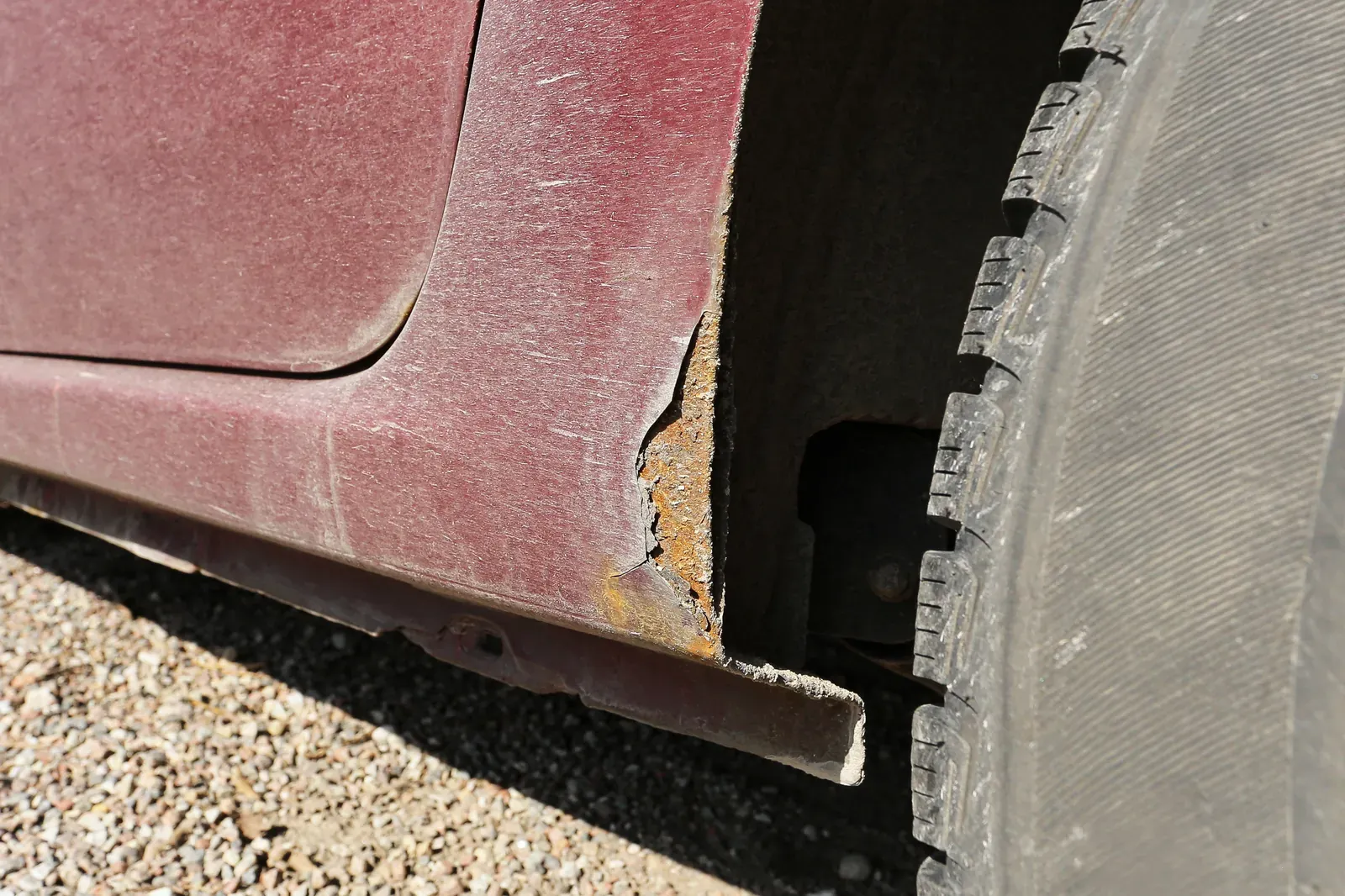
Why the rocker is always first to go
The rocker is the lowest painted steel on the car, riding inches from the front tire’s spray all winter. Everything the tire lifts — brine, sand, gravel — either blasts the rocker’s leading edge or settles onto its pinch weld and sits there. Add plastic sill covers on many models, which quietly trap wet grit against the paint, and you have a panel living in worse conditions than any other on the vehicle.
Rockers also rot from the inside. They are hollow box sections with drain holes along the bottom, and when those drains plug with sand, meltwater pools inside the cavity. That is why a rocker can look clean in fall and show a line of bubbles by spring: the corrosion started on the surface you could not see.
Ride height compounds it. Low sedans carry their rockers directly in the densest band of wheel spray, while trucks and SUVs collect the same grit across a taller panel. Either way, the rocker absorbs what the road throws for the entire season, while the hood and roof only ever see weather from above.
Reading the damage from outside
A single blister near a wheel opening reads very differently from a soft row of bubbles running the panel’s length. The first is often a stone strike that was left open; the second usually means moisture inside the box section has been working for a while. A crusty, scaly bottom lip is the most serious sign, because it points at the pinch weld — the seam that also serves as the factory jack point.
The honest caveat: the outside never tells the whole story on a rocker, because the panel is built as an outer skin over an inner structure. Our teardown-first estimating exists for exactly this situation — we look behind the panel before committing to a final number, so the estimate reflects what is actually there.
One more clue you can check yourself: open the doors and inspect the painted sill under the weatherstrip. Corrosion that has climbed to the inner sill means the cavity has been wet for a long time, and it usually moves the conversation toward replacement before the car is even on a lift.
Repair or replace: how the call gets made
A short corroded section with sound metal around it gets cut out and rebuilt with a welded patch, then finished and refinished — the smallest honest version of the job. A long run of bubbling usually argues for a partial or full rocker replacement panel instead, because chasing corrosion patch by patch down a panel costs more than replacing the skin once.
The deciding vote belongs to the inner rocker. If the inner structure is clean, outer-skin work of either kind holds up well. If the inner rocker is going too, the math changes quickly, and we would rather show you that with the cover off than discover it after you have approved a smaller repair.
Replacement is not automatically the premium choice, either. On some models a formed rocker section costs less than the hours a long multi-patch repair would demand; on others, panel availability is thin and careful patching is the only sensible route. This is why we quote the specific car instead of reciting a rulebook.
What moves the price up or down
We do not quote rocker work sight unseen, but the factors are consistent and worth knowing before you collect estimates. None of them are mysterious — they are all about how much metal is involved and how much of the car has to come apart to reach it.
- Length of the corroded run — one blister versus the whole panel
- Whether the inner rocker structure is involved
- Replacement panel availability for your specific model
- Sill covers, trim, and door edges that must come off for access
- How far the refinish must blend into the door and quarter panel
- One side of the car or both — they rarely age identically
When we will tell you to stop
Rockers contribute to the body’s stiffness, and they carry the jack points. When rust has gone through the inner rocker or into the floor edge, the fix is structural fabrication — a restorer’s trade, not a collision shop’s. On a special car that is money well spent with the right specialist, and we will point you to one. On a tired commuter, it is usually money better kept.
That answer costs us work, and we give it anyway. A repair we cannot warranty is a repair we do not want our name on, and quietly skimming a structural rocker with filler to win a job is the kind of shortcut this shop was built to be the alternative to.
And there is no shame in that outcome. Minnesota retires bodywork earlier than almost anywhere, and a rocker that finally gives up after years of salt service belongs to a car that did its job. The useful question is simply whether this particular car has earned the next chapter.
Getting it scheduled
No insurance company reimburses gradual corrosion, so treat rocker work like planned maintenance: photograph both rockers in daylight, send the pictures over, and you will have a free written estimate within 1 hour. Fall is the smart deadline — a blistering rocker that crosses another salt season comes back a bigger job.
Every rocker we repair is seam-sealed, protected inside the cavity, and refinished under our written lifetime paint warranty. If you would rather talk it through first, call (651) 460-9996 or stop by 8080 W 125th St Unit G in Savage.