
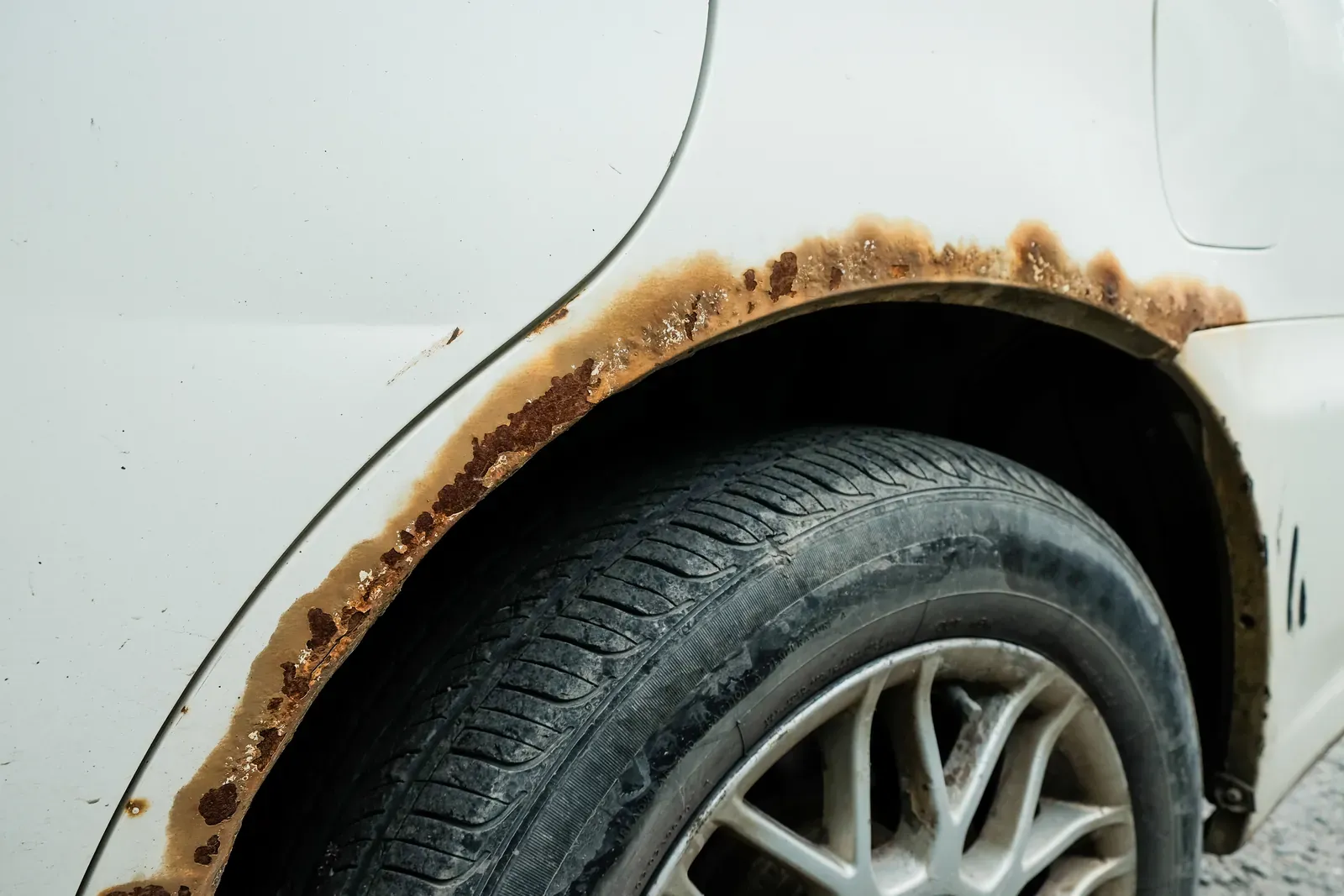
The liner trap: why arches rot
Every rotation of the tire throws slush upward, and a share of it lodges in the space between the plastic liner and the steel arch. Unlike the hood or the doors, that pocket gets no airflow and no sun, so the pack of salty grit stays damp long after the roads have dried. The steel above it soaks in brine for weeks at a stretch.
The arch lip makes it worse. On most cars the lip is a hem — the outer skin folded back over an inner flange — and that fold wicks moisture in and will not let it back out. Corrosion gets to work inside the hem, invisible, and only announces itself once it has pushed up through the paint on the face of the panel.
Behind the arch on many vehicles sits a second trap: the low shelf where the quarter meets the bumper or the sill, where thrown mud settles and dries into a sponge. Every drive re-wets it, every thaw feeds it salt, and the steel behind it stays damp long into spring. When we open arches for repair, that shelf is where the surprise usually lives.
A bubble on the arch is a late symptom
By the time you can spot blistering from standing height, the process is established in the fold and moving along it. This is the pattern our road salt rust page describes across the whole car, so we will not repeat it here — the arch-specific point is direction. Hem corrosion travels the curve of the lip, which is why a spot ignored in December reappears in April as an arc.
That is also why arch quotes based on the visible bubble alone tend to grow. We estimate arches expecting the fold to be involved, and we would rather set that expectation in the written estimate than surprise you with it after the wheel comes off.
For a second data point that needs no tools, look at the arch from directly behind the car at bumper height. Hem corrosion often telegraphs as a faint ripple or shadow line along the lip before the paint ever breaks. Spotting it there is genuinely early — the stage where the repair is at its smallest. It costs nothing to make that glance part of every seasonal tire swap.
Fender or quarter panel: two different jobs
A front fender bolts to the body. When one rusts badly, replacing it with a new or clean used fender and painting it to match is often simpler and more durable than surgery on the old panel — a judgment we make case by case based on parts availability for your model.
A rear quarter is welded structure, so nobody sensibly replaces one for arch rust. Instead, the corroded lip section is cut out and a formed repair section — available off the shelf for many popular models — is welded in and finished. Same result at the arch, entirely different scope behind it.
Cost follows that split. Fender work tends to be bounded and predictable because the panel unbolts and the paint stays local. Quarter work happens near glass, interior trim, and often the fuel filler, so the same size of visible rust runs higher on a quarter than on a fender. Location writes the estimate, not the bubble.
What a proper arch repair includes
Done right, arch work happens from both sides of the steel. The wheel and liner come out first, because repairing the outside while leaving a wet grit pack against the inside is a half-repair with a short life expectancy.
The refinish deserves equal billing with the metal work. An arch sits at eye level from the sidewalk, so color and texture must carry across the quarter, the door edge, and often the bumper corner. That is booth-and-blend territory — computerized color match, then clear across the blend zone — and it is why a finished arch should be impossible to pick out in sunlight.
- Wheel and arch liner removed, the pocket cleaned to bare steel
- Corroded lip and panel sections cut back until clean metal shows
- New steel welded in and the hem dressed to the factory profile
- Seams sealed and the cavity behind the arch protected
- Panel refinished and blended so the arch matches the door and bumper
- Liner refitted with its fasteners replaced, not zip-tied
Keeping the next arch from starting
Prevention at the arches is mostly housekeeping. Rinse the wheel wells during winter thaws so the grit pack never settles in, refasten any liner that flaps or sags — a loose liner funnels spray straight onto painted steel — and seal stone chips on the lip while they are still shiny. Our undercoating guide covers the deeper protective options with an honest eye.
And when a bubble does appear, move on it. Insurance policies exclude corrosion, so there is no claims process to wait on — just a repair whose price tracks how far along the fold it has traveled. Photos of the arch straight-on and at an angle are enough for a free written estimate within the hour.
What does not work is ignoring the liner because the paint above it still looks fine. Liners loosen quietly — a lost fastener at the car wash, a snowbank tug — and the damage they permit shows up a season later, where nobody connects the two events. A minute spent checking fasteners each spring protects paint you already paid for.