
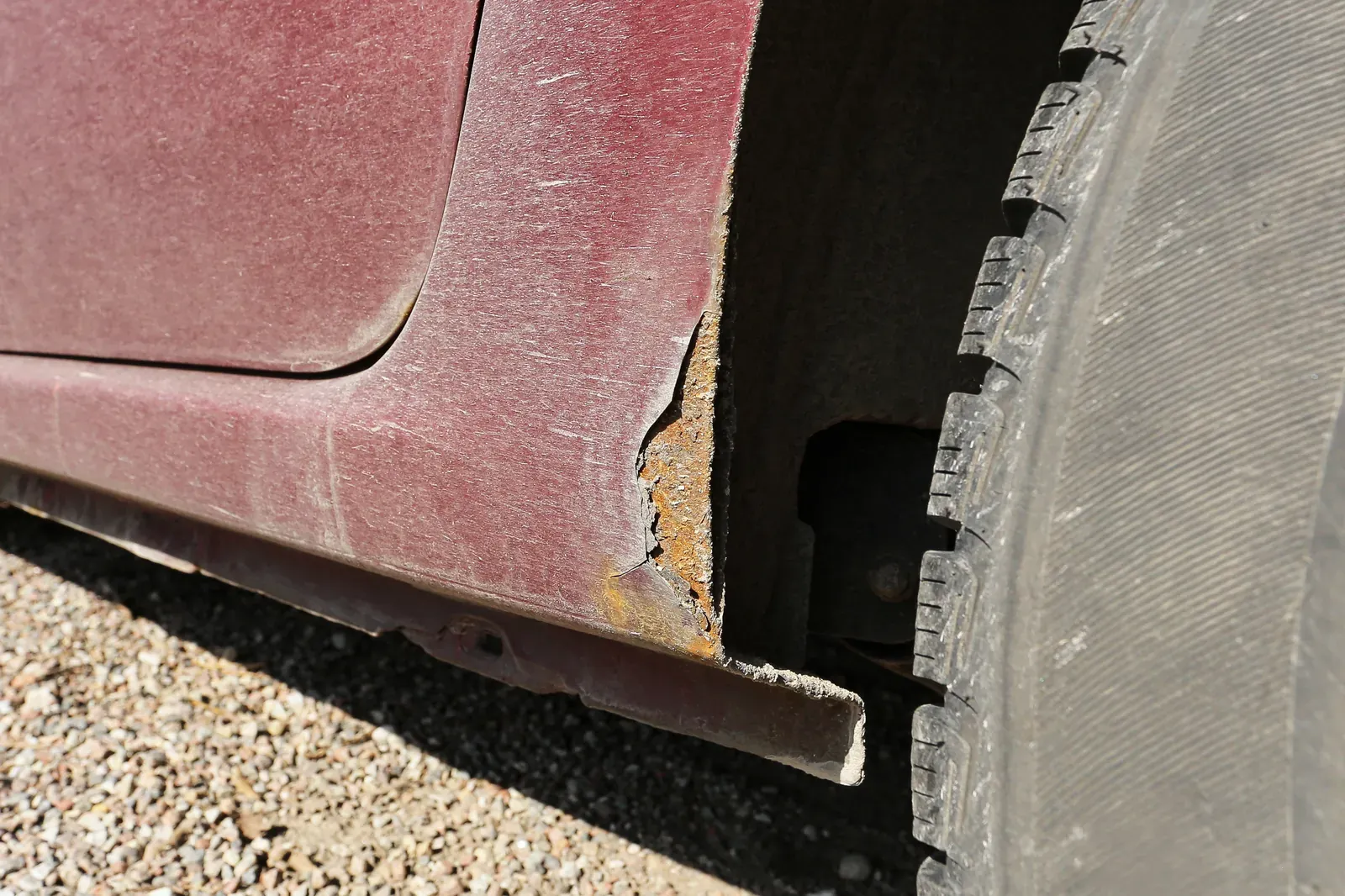
What rust does inside a buyer’s head
Rust is the flaw that talks. A dent says something happened once; visible corrosion says the car was let go, and shoppers extend that story to everything they cannot see — the maintenance, the fluids, the frame. That is why bubbled paint suppresses offers well beyond what the repair would cost: buyers are not pricing the spot, they are pricing the doubt. None of this is fair to a good car, but markets price stories, and rust tells a bad one.
It also filters who calls at all. Online shoppers scroll past listing photos with visible bubbling and never become negotiators, so the rust quietly shrinks your market before price is even discussed.
And there is a second audience reading the rust: the people your buyer consults. Spouses, mechanic friends, and forum threads all treat visible corrosion as a bright flag, and a private sale usually needs every one of those voices to say yes. A repaired panel does not just change one mind — it removes the objection each advisor in the buyer’s corner was going to raise.
Repairs that tend to earn their money back
The high-return fix is a small number of prominent spots on a car that otherwise presents well: an arch bubble, a rocker blister, a browning chip on the hood. Repairing and blending those panels — paired with a thorough cleaning inside and out — changes the listing photos completely, and the photos are what fill your inbox. Buyers forgive a repaired panel with paperwork far more easily than they ever forgive the bubble itself.
This only works before perforation, while the repair is still contained booth work. That is our lane as a collision and refinish shop, and it is the version of pre-sale reconditioning where the arithmetic genuinely tends to favor the seller.
Order matters when preparing the listing: repair first, then detail, then photograph — never the reverse. Shooting photos before the repair just to get it posted bakes the rust into an ad that will follow the car around the internet, and re-listing later with better pictures raises the exact suspicion you paid to remove. One clean launch outperforms two mixed ones.
Repairs that usually do not pay
Widespread corrosion at every corner rarely rewards repair at sale time — the spend approaches restoration economics, and restoration is a specialist trade with costs no resale bump will cover on an ordinary car. Structural rust through rockers or floor edges lands in the same category, with the added weight of being a safety disclosure, not just a cosmetic one.
For those cars the stronger play is selling honestly into the right market: mechanically minded buyers and project hunters price rust with open eyes, and a fair as-is price finds them faster than a disguise finds anyone.
A note on the borderline car — solid drivetrain, honest interior, one big rust problem: get the estimate before assigning it a category. Sellers misjudge this line in both directions, paying for repairs the market will not reward or dumping a car whose one visible flaw was affordable to erase. The written number sorts it in minutes, and pricing honestly for the project market beats waiting months for a retail buyer who will not appear.
Fix it — and then say so
A professional rust repair is not something to hide from a buyer; it is evidence of care. Hand over the written estimate and invoice, note the lifetime paint warranty that covered the refinish, and the story flips from “this car rusted” to “this owner fixed things properly.” Documentation like that routinely outperforms silence in a private sale. Keep digital copies too, so the records survive the glovebox.
The line never to cross is concealment: skimming perforated metal with filler or spraying undercoat over rot to survive a test drive. Buyers bring inspectors, inspections find it, and misrepresenting known damage can follow you well past the handshake. Repair honestly or disclose honestly — those are the two good options.
Trade-ins reward the same honesty for a more commercial reason: the appraiser is pricing risk, and paperwork removes risk. An estimate, an invoice, and a warranty document give the appraiser something concrete to write beside the number, which is what moves a car out of the automatic-auction pile. Silence leaves them pricing the worst case, and the worst case is never in your favor.
Settle it with one number
The decision needs exactly one fact you do not have yet: what the repair costs. Photos of each spot get you a free written estimate within 1 hour. Set it against the asking-price gap between rusty and clean examples of your model in the local listings — their numbers, not ours — and the answer usually declares itself. Match condition like-for-like while you compare: the clean listings are clean everywhere, so worn tires or a chipped windshield belong in the same arithmetic. Rust is usually the biggest lever on presentation, but it is rarely the only one.
Remember there is no insurance shortcut here; corrosion is excluded from standard policies, so the estimate is the entire money picture. And if what the photos show is past sensible body-shop economics, we will say that plainly and save you the trip — an honest no is still useful information the night before you write a listing. Either way, you walk into the sale holding the two things buyers cannot argue with: a documented condition and a price built on it.
