The real question: where can the paint stop?
When someone asks whether we can paint just the scratch, they’re usually picturing paint as a patch — cover the bad spot, done. But refinish paint doesn’t fail at the scratch; it fails at its own edge. Wherever new clearcoat ends, there’s a boundary, and that boundary needs somewhere honest to be: a panel gap, a body line, a molding, an edge the eye already expects. Give the paint a natural stopping point and the repair can vanish. Strand the edge in open panel and you’ve traded a scratch for a ring.
So the size of the damage matters less than its address. A small scratch in a bad location needs more paint than a bigger one in a good location — which is the single idea that makes every confusing paint quote suddenly make sense.
Where spot repairs genuinely work
Plenty of damage lives at a good address. A scrape low on a bumper corner sits on a part that’s bounded on every side by its own edges. A chip near the trailing edge of a fender gives the clear a gap to run to. Damage tucked below a strong body line lets the refinish end where the light already breaks. In all of these, a partial repair is legitimate, durable work — the color is still blended within the area, and the clear still runs to a real boundary.
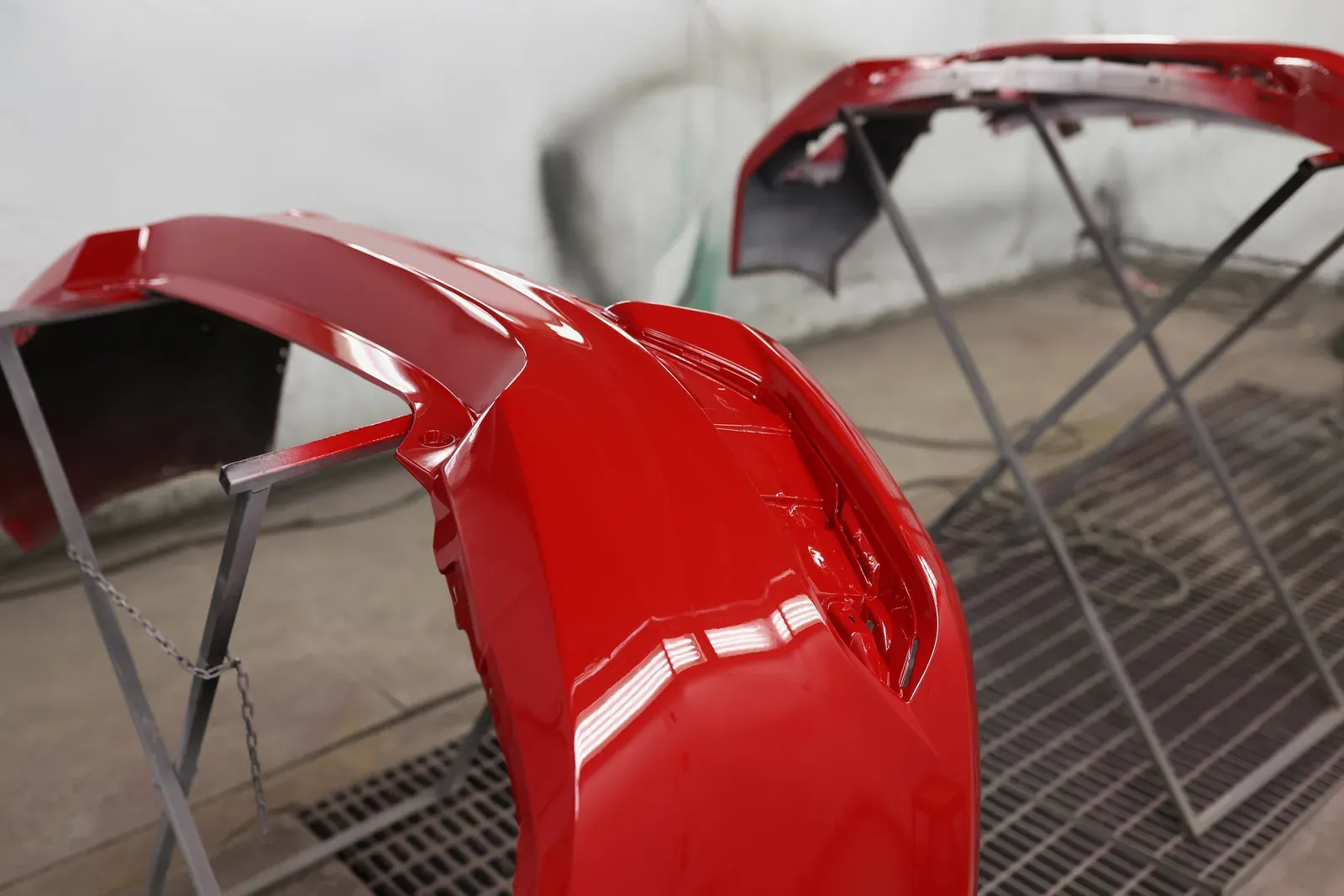
Bumpers are the friendliest territory of all. They’re separate parts, so every edge is a natural stopping point, and many have textured lower sections that create additional built-in boundaries. That’s why small bumper repairs are often practical and economical when the identical scuff on a door would call for the full panel.
A reality check belongs here, though: “near an edge” means the repair genuinely reaches that boundary, not that an edge exists somewhere on the panel. The clearcoat still has to travel from the damage to its stopping point, and everything it crosses gets refinished along the way. A scrape a hand-width from the fender’s trailing edge is a great candidate; the same scrape in the fender’s center is just a smaller version of the hood problem.
The middle-of-the-hood problem
Now put the same scratch dead center on a hood. The hood is horizontal, lit by the whole sky, and — on most modern cars — metallic, so the flake angle makes any transition doubly visible. There is no body line to hide an edge and no gap to run the clear to. A spot repair here leaves a boundary in the most merciless light a car has, and it tends to become more visible with time and washing, not less.
There are products for melting a clearcoat edge into surrounding paint, and in hidden areas they have their uses. On open horizontal panels, that melted edge is where early failures start — dulling, a visible halo, eventually a line you can catch a fingernail on. When we decline to spot-repair a hood or roof, that’s the failure we’re declining, not the work.
Doors split the difference. Vertical panels live in kinder light than hoods, but the same edge logic holds: damage near a shutline or below a strong character line gives the paint somewhere honest to stop, while damage dead center on a flat door skin usually doesn’t. On a metallic, the halo risk in mid-door is real enough that whole-panel is our default answer there — and we’d rather explain that up front than have you discover it in your driveway.
What “the whole panel” actually means
When the honest answer is the full panel, here’s what you’re buying: the damaged panel refinished edge to edge, with clearcoat ending at real boundaries, and the color faded into the adjacent panels so no transition exists for the eye to find. Blending is its own subject — we’ve explained it separately — but the point here is that the extra scope isn’t padding. It’s the mechanism that makes the repair disappear.
This is also the honest context for cost questions. The price of paint work tracks where the paint must stop, not the length of the scratch, which is why a one-panel repaint quote can look outsized next to the blemish that caused it. Our one-panel cost explainer walks through those factors without pretending a number fits every car.
Cheap now, or right once
A spot repair in the wrong location doesn’t really save money; it defers spending it. The halo shows, it bothers you a little more each month, and eventually the panel gets done properly — after paying twice. The genuinely budget-smart moves are different ones: let a bumper’s natural boundaries work for you, seal a chip promptly so it stays a chip, or decide with open eyes to live with cosmetic damage until a bigger repair makes sense.
If you’re not sure which address your scratch lives at, that’s a photo problem, not a visit problem. Send us pictures and you’ll get a written estimate — with an honest verdict on whether a spot repair will hold up or whether we’d be taking your money twice.
One more distinction saves people real money: not everything that looks like it needs paint actually does. Transfer from the other car’s bumper, scuffed wax, and marks that haven’t broken through the clearcoat can often be polished away entirely — no edges, no blending, no booth time. That check takes seconds in person and minutes from photos, and it’s the first thing we rule out before anyone starts talking about panels. It’s also the happiest phone call we get to make.