
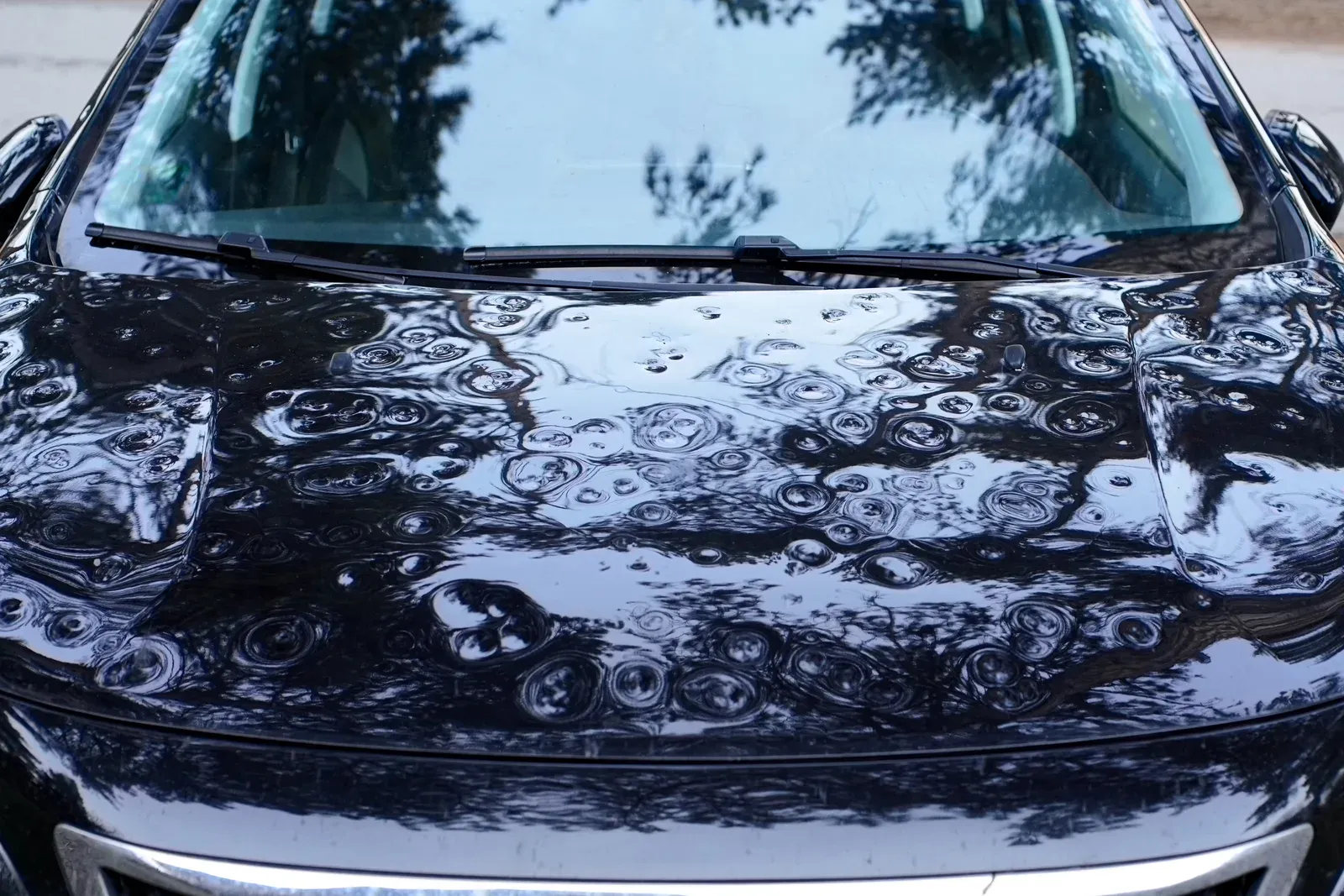
The knock that follows every Minnesota hailstorm
Within days of a good hailstorm, crews sweep through the affected neighborhoods — canvassers at the door, tents in parking lots, flyers under wipers, trucks with out-of-state plates. They chase storms across the country for a living, and by the time they reach your porch the pitch is polished: free inspection, we handle your insurance, sign here and it costs you nothing.
Not every traveling crew does bad work. The structural problem is accountability. When the season ends they leave Minnesota, and if your paint bubbles, your dents shadow through in low sun, or your headliner rattles where it was pulled, there is no counter to walk up to. A warranty is only as real as the address behind it, and a tent has no address.
What the clipboard paperwork can actually say
The document to slow down for is an assignment of benefits. Sign one and you hand the crew the right to deal with your insurance company directly — to negotiate the claim, to receive the payment, sometimes to pursue disputes in your name. You have converted your claim into their asset while remaining the person responsible for the car.
Read for the other quiet clauses too: cancellation terms that make backing out expensive, fees owed if you decline their repair after their inspection, and authorizations broad enough to cover work you never discussed. None of this is illegal on its face. All of it deserves a slow read at your kitchen table, not a signature on a doorstep.
Red flags you can spot in two minutes
You do not need to be an expert to filter hard sells from honest offers. Any one of these is a reason to pause; two or more is a reason to close the door politely.
Notice that urgency itself is the tell. Hail damage does not worsen sitting in your driveway the way a leak or a crack does — the dents you have today are the dents you will have next month. Anyone manufacturing a deadline around damage that has no deadline is selling the pressure, not the repair.
- Pressure to sign today — a legitimate shop’s estimate is still valid next week
- An offer to make your deductible disappear
- No fixed local address you can visit, or a tent and a truck standing in for one
- They approached you before you ever contacted your insurance company
- Vague or verbal warranty promises with nothing in writing
- They want the insurance check made out to them, or signed over on the spot
The deductible-waiver promise, examined
Making the deductible vanish is the oldest hook in storm work, so it deserves its own paragraph. The money comes from somewhere. Either the repair is quietly cheapened until the math works, or the claim submitted to your insurance company is padded to absorb it — and misrepresenting a claim is a serious matter that lands on the policyholder, not just the crew.
A straightforward shop will talk to you plainly about your deductible instead of performing magic tricks with it. If the opening offer involves creative paperwork, assume the rest of the job runs the same way.
What legitimate hail repair looks like
The core technique the traveling crews sell — massaging dents out from behind the panel so the factory paint stays untouched — is real, and it is the right call for much hail damage. The technique is not the issue. The issue is who stands behind the workmanship when a dent shadow shows up next summer, and whether panels that need refinishing get real paint work or a glossed-over shortcut.
A fixed shop handles the whole spectrum: dent removal without repainting where the panel qualifies, proper refinish in a downdraft booth with computerized color matching where it does not, and a written warranty either way. We photograph the damage panel by panel, write the estimate, and work directly with every insurance company — your claim stays yours from start to finish.
The sequence with a legitimate shop is also reversed. You call your insurance company first, open the comprehensive claim, and then choose where the work happens — rather than signing with a stranger and letting them introduce themselves to your claim. Hail runs through comprehensive coverage, and the claim process is unhurried enough to do in the right order.
Already signed something? Do this now
Do not assume you are stuck. Reread the document for cancellation language — many contracts can be cancelled within a short window or before work begins, and the sooner you act the cleaner the exit. Put your cancellation in writing, date it, send it by a method you can prove, and keep copies of everything.
Then call your insurance company, tell them exactly what you signed, and ask whether an assignment of benefits was recorded on the claim. If work has not started, most situations can be unwound. If you are unsure where you stand legally, that is a conversation for an attorney — our lane is making sure the car itself ends up repaired properly.
And if a crew already worked on the car and the result worries you, document it before winter weather complicates the story: photos of every panel in raking light, copies of whatever paperwork you received, and a second opinion from a shop that can put its findings in writing. Problems surface faster than storm crews return.