The short, honest answer
Factory paint and refinish paint are different processes with different strengths, and pretending otherwise in either direction is salesmanship. The factory has advantages a shop physically cannot reproduce. A shop has advantages an assembly line was never designed to offer. What actually decides whether your repainted fender still looks right years from now isn’t which process touched it — it’s whether the shop’s prep and cure were done properly. That part varies enormously between shops, which is why this comparison is worth five minutes of your time.
It’s also the fair frame for a worry we hear at the counter all the time — that a repainted panel is somehow permanently second-class. It isn’t. Refinishing is how every repaired vehicle on the road got back to looking like itself, and done well it’s invisible to everyone but a paint meter. The interesting question was never whether shop paint can equal the factory’s appearance; it can, and our gallery is full of the proof. The interesting question is what separates repaints that hold up from repaints that don’t — which is exactly what the rest of this page unpacks.
What the factory does that no shop can
Before a new vehicle has wiring, glass, plastic, or seats, its bare steel body is submerged in an electrocoat bath — a corrosion-protection layer drawn into every seam and cavity by electrical charge. No repair shop can dip your assembled car in a tank, full stop. That e-coat layer is the factory’s quiet masterpiece, and good collision repair works to preserve it wherever metal isn’t being replaced.
The factory’s second advantage is heat. Because the shell is bare, its paint can be baked at temperatures that would destroy an assembled car’s trim, wiring insulation, and electronics. That hot bake produces a very hard film straight off the line. Add robotic application — the same gun path, the same film build, on every body — and you get the factory’s real signature: consistency.
It’s worth being clear about what those advantages are for, though: protecting a car that never gets damaged. The moment a panel is dented, scraped, or rusted, the factory’s sealed system is already broken at that spot, and no amount of assembly-line nostalgia repairs it. From then on the choice isn’t factory paint versus shop paint. It’s a good refinish versus a bad one.
What a refinish does that the factory doesn’t
The factory paints to a standard. A shop paints to your car. By the time a vehicle reaches us, its finish has drifted from the code on the door jamb — sun, seasons, and car washes see to that — and the factory has no mechanism for chasing that drift. A refinish does: the color is tinted against the panel it must live beside, then blended so no hard edge exists. That’s something an assembly line has never done for anyone.
Refinishing has two other genuine advantages. Clearcoat can be applied more generously than the factory’s tightly economized film, giving the repaired area real depth of gloss. And where the factory relies on sampling and sensors, a refinish gets a human being looking at one specific panel under light, correcting nibs, and polishing the finish to agree with the paint around it. Mass production versus attention — each is better at what the other can’t do.
There’s a reason the compliment we hear most often is that nobody can tell the car was ever painted. Matching an aged, sun-drifted color by hand, then blending it until the transition stops existing, is the one part of this trade where craft beats automation outright — and it’s the part your repair actually depends on.
Cure is the equalizer
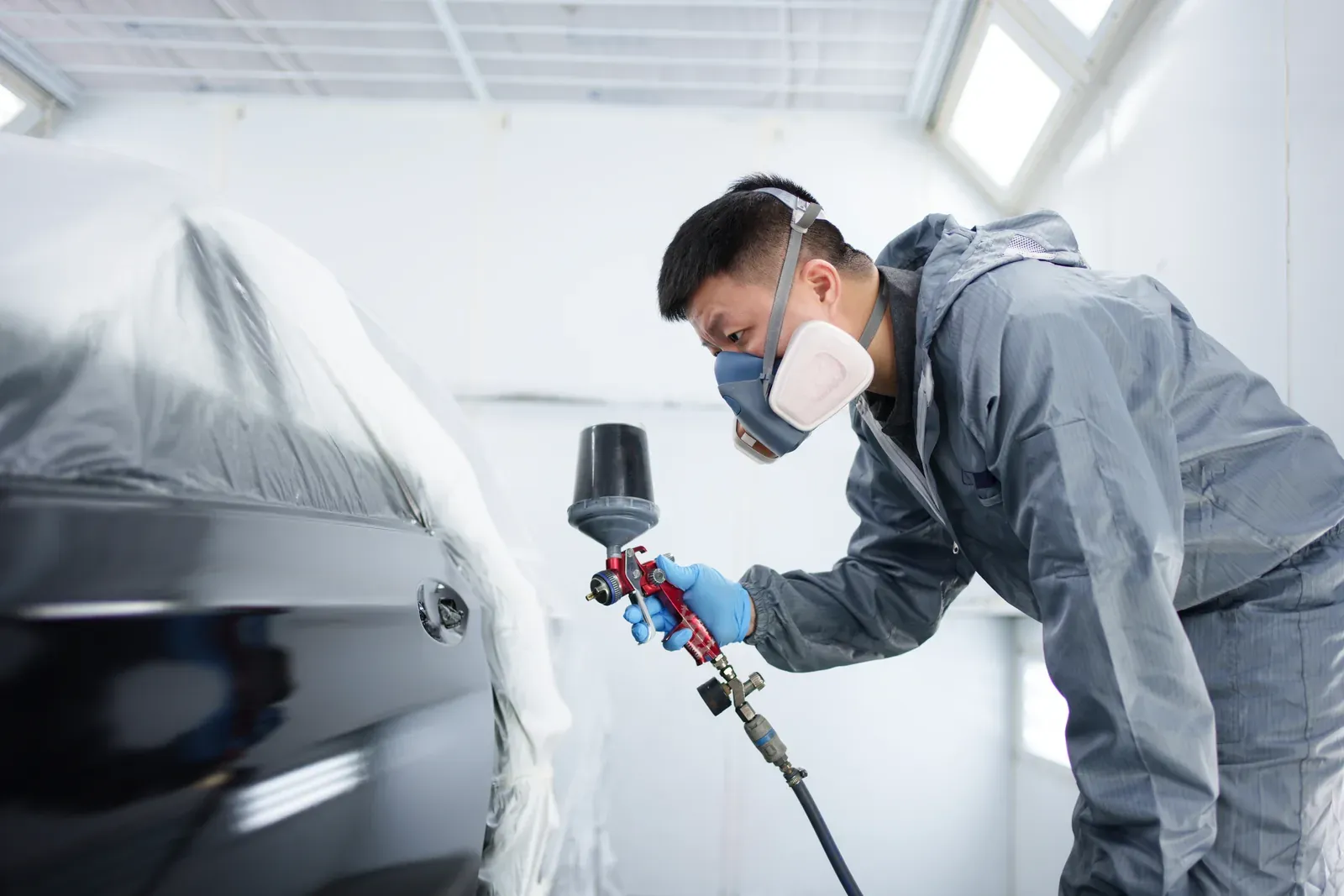
Refinish paint isn’t factory paint sprayed cold — it’s a different chemistry, engineered to crosslink and harden at the moderate temperatures a spray booth can safely hold with an assembled car inside. Cured correctly, modern refinish clear is a durable, weatherable film. This is settled territory in the industry, not a compromise a shop apologizes for.
When a repaint fails early — peeling edges, dulling, cracking — the autopsy almost never blames the chemistry. It blames the process: contamination sealed under the clear, primer steps skipped, film sprayed thin, or a cure that was rushed or uncontrolled. Booth conditions are their own subject, and our downdraft booth page walks through them, so we’ll simply say here: the equipment exists precisely to take those failure modes off the table.
How to judge a refinish
Forget the factory-versus-shop debate and apply two tests. First, can you find the repair? Stand back in daylight, move around the car, look along the bodyside at a shallow angle. A proper refinish gives you nothing — no color step, no texture change, no gloss halo. Second, what happens if you can find it later? A shop confident in its prep and cure will put a warranty on paper; ours covers the paint work for as long as you own the vehicle.
Those two answers tell you more than any material comparison. The factory’s advantages protect a car that never gets hit. After a repair, what protects you is the shop’s process — and its willingness to sign its name to the result.
A shop’s confidence shows in what it invites you to do. Walk the finished car in daylight, sight down the bodyside, open the doors and check the edges — we built our delivery around that inspection rather than hoping you’ll skip it, because on a properly refinished car there’s nothing for it to find. And if daylight ever does find something later, the warranty page of your paperwork is the shortest road back.