How does sun and UV damage car paint in Minnesota?
Quick answer
Ultraviolet light breaks the chemical bonds in your clear coat and in the pigments beneath it. The clear coat contains UV absorbers that take the hit first, and once those are used up the resin itself starts degrading — gloss goes flat, a chalky haze appears, and eventually the clear cracks and peels. Horizontal panels fail first because they face straight up.
What UV actually does to a finish
Automotive paint is a polymer. Ultraviolet photons carry enough energy to break the chemical bonds holding those polymer chains together, and every hour of sunlight breaks a few more.
Manufacturers fight this by loading the clear coat with UV absorbers and light stabilizers — molecules that intercept UV energy and release it harmlessly as heat. They work extremely well and they are consumed doing it. They are a fuel tank, not a permanent shield.
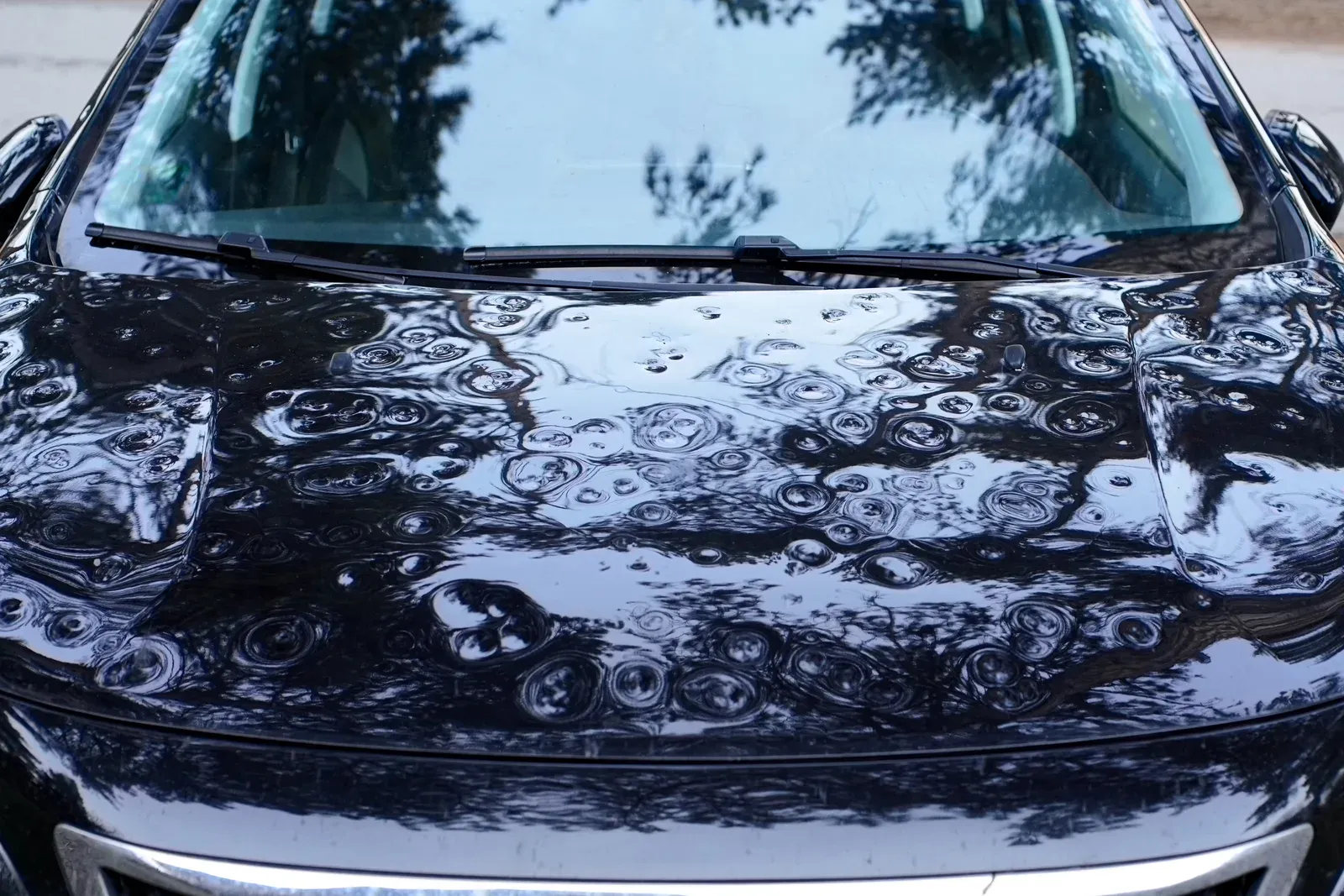
Once they are depleted, degradation moves to the resin itself. The surface loses gloss, then goes hazy and chalky, then develops a network of fine cracks. Water gets into those cracks, adhesion between clear and base lets go, and the clear starts lifting in sheets.
Pigments degrade too. Reds and some organic pigments are the most vulnerable, which is why an old red car fades toward pink and dark colors go flat and gray. That fade is also why matching paint on an older car means measuring the panel rather than mixing from the factory code.
Why Minnesota is harder on paint than people expect
The assumption is that UV damage is an Arizona problem. Minnesota has its own combination, and it is not gentle.
Summer days here are long. In June the sun is up for more than fifteen hours, and cumulative exposure is what matters, not peak intensity. Snow and light pavement also reflect UV back upward, so panels get exposure from below and at angles in winter that they would not get elsewhere.
Then there is thermal cycling. A dark hood in Savage can sit below zero in January and well over a hundred degrees in July, and the paint film expands and contracts through that entire range. Every cycle stresses a film that UV has already weakened, and it accelerates the microcracking that starts delamination.
Add road salt, sand, and freeze-thaw to that and you get a climate that attacks paint from several directions at once. A car that spends ten years outdoors in the metro has been through a genuinely demanding test, and it usually shows on the roof first.
What fails first, and in what order
UV damage follows the sun, so it is entirely predictable:
- Roof, hood, and trunk lid — horizontal panels take the most direct exposure and run the hottest
- The upper third of vertical panels, particularly on the side that faces the street where you park
- Plastic trim and mirror caps, which chalk and turn gray
- Headlamp lenses, which haze yellow as their factory UV coating degrades
- Wiper cowls, roof rails, and other black plastic parts
- Vinyl wraps and graphics, which fade and shrink before the paint under them does
- Dashboards and interior plastics, through the windshield
- Rubber weatherstrip and seals, which harden and crack as they dry out
What actually slows it down
Shade is the single most effective thing. A garaged car and a car that lives outdoors age very differently, and there is no product on the shelf that closes that gap. Even a carport or a shaded side of the driveway helps.
Beyond that, keep a sacrificial layer on the paint. Wax lasts a couple of months, a synthetic sealant lasts longer, and a ceramic coating longer still. All of them take some UV and contamination so the clear coat does not, and all of them make the surface easier to clean.
Wash regularly. Bird droppings, tree sap, and industrial fallout are acidic and etch into clear coat, and etched spots become failure points. Get them off the same day rather than letting them bake.
Do not over-polish. Every aggressive polish or buff removes a small amount of clear coat, and clear coat is finite. Repeatedly polishing an old finish to bring back shine is spending down the layer that is protecting the color.
A short version of the routine:
- Park in a garage or shade whenever there is a choice
- Wash every couple of weeks so contaminants do not sit and etch
- Remove bird droppings and sap the same day
- Keep a wax, sealant, or ceramic coating on the finish
- Polish sparingly, and only when the finish actually needs it
- Address hazing on the roof or hood early, before it cracks
When it is past prevention
There is a point of no return. Once clear coat has cracked or started lifting, no polish, sealant, or restorer product can rebuild it — the film has failed structurally and there is nothing to polish.
At that stage the only real fix is refinishing: sanding the failed clear off, taking the panel down to a sound layer or to primer, sealing, and spraying fresh base and clear to a natural break line.
The good news is that catching it at the hazy stage usually means one panel instead of half the car. If the roof or hood has lost its reflection compared to the doors, that is the moment to have it looked at.
There is a Minnesota reason not to wait, too. Once the clear is gone and the base coat is exposed, the panel goes into a winter of salt and freeze-thaw with essentially no protection, and a paint job turns into a paint job plus corrosion work.
We match color to the car as it is today with computerized color matching, blend into the adjacent panels so the repair has no edge, and warranty our paint and refinish work for life.