What causes paint to peel on a car roof and hood?
Quick answer
What is peeling is almost always the clear coat, not the color. Roofs, hoods, and trunk lids face straight up, so they absorb far more ultraviolet energy and run much hotter than vertical panels. The clear coat’s UV absorbers deplete, the film cracks, adhesion to the base coat fails, and it lifts in sheets. It spreads from every exposed edge and never stops on its own.
What is actually peeling
Look at the peeled area closely. If the exposed surface underneath still has color but looks flat and matte, the clear coat has come off and the base coat is showing. That is the common case by a wide margin.
If the exposed area is gray, white, or dark and has no color at all, the failure went deeper and the base coat has come off too, leaving primer. If it is bright metal, everything is gone and corrosion is already running.
The distinction matters because base coat has essentially no durability or UV protection on its own. Once it is exposed it fades fast, and once primer is exposed it absorbs moisture. A peeling roof gets worse quickly rather than holding steady.
Reading the panel, from best case to worst:
- Dull, flat patches with full gloss elsewhere — clear coat oxidizing, still intact
- A chalky haze that does not polish out — clear coat degrading
- Fine cracking visible up close — clear coat failing, refinish territory
- Color visible but matte where the clear lifted — base coat exposed
- Gray or white areas — primer exposed, moisture is getting in
- Bright metal or brown spotting — corrosion has started
Why horizontal panels and not the doors
A roof faces the sky. It receives direct sunlight for most of the day at the most efficient angle, while a door only catches it obliquely and only for part of the day. Over years, the difference in accumulated UV energy is enormous.
Heat compounds it. Horizontal panels reach much higher surface temperatures, and heat accelerates every chemical reaction involved in breaking down the film. A dark hood in July is one of the harshest environments a polymer coating faces anywhere on a vehicle.
Horizontal surfaces also hold everything that lands on them. Rain, dew, bird droppings, tree sap, and pollen sit and dry in place instead of running off, and the acidic ones etch into the film and create the starting points for failure.
Snow does its part in Minnesota. Snow sitting on a roof for days keeps the surface wet and cold, then reflects UV back at the panel once the sun comes out, and the scraping that removes it adds mechanical wear on top.
The other causes worth knowing
UV is the main driver, but several other things start or accelerate peeling:
- Thin factory clear film build, common over aluminum hoods and some plastic panels
- Adhesion failure between clear and base from contamination or a curing problem — at the factory or in a prior repair
- A previous inexpensive repaint sprayed without proper sanding, sealing, or a UV-stabilized clear
- Repeated aggressive polishing or buffing, which physically thins the clear until it has nothing left to give
- Roof racks, cargo boxes, and magnetic signs that trapped grit and moisture against the surface
- Vinyl graphics or wrap removed after years, taking weakened clear with them
- Acid etching from bird droppings and sap left to bake in
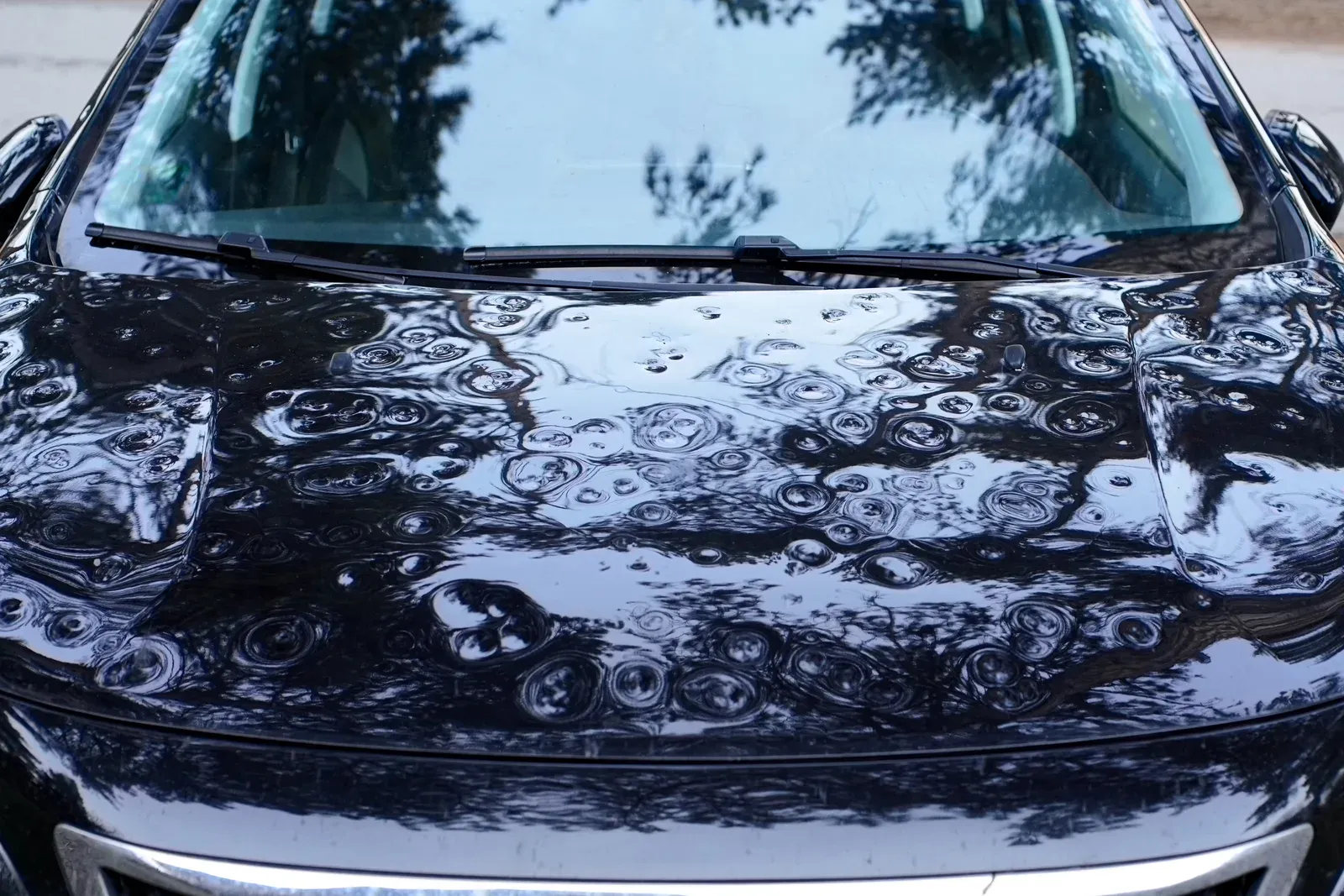
- Hail dents that cracked the film, letting water in from the edges
- Automatic brush washes over many years, which put fine scratches into the clear
Why it cannot be spot-repaired or restored
Peeling clear coat has a failed edge, and that edge keeps lifting. Wind, washing, and freeze-thaw all pull at it. Sanding just the peeled patch and clearing over it leaves the surrounding weakened film in place, and it will fail next to the repair within a year or two — usually in a slightly different spot, so it looks like a new problem.
Products sold as clear coat restorers are polishes. They remove oxidation and fill fine scratches, which genuinely helps a dull but intact finish. They cannot rebuild a film that has delaminated, because there is nothing left to level.
The correct repair takes the whole panel back. The failed clear is sanded off, the panel is taken to a sound layer or to primer, sealed, and refinished with fresh base and clear carried to a natural break line — because a clear coat edge in the middle of a flat panel will always show.
What a proper roof or hood refinish involves
On a roof, the surrounding panels usually have to be considered as well. Roofs have few natural break lines, so the refinish typically covers the entire panel, and the color is blended into the pillars and the tops of the quarters so there is no transition to see.
Color is matched to the car as it is today. This is important on a sun-damaged vehicle, because the doors and quarters have faded along with the roof, and a fresh factory-code mix would leave the new roof visibly brighter than the rest of the car.
Get to it before the base coat is gone. Refinishing over intact base is a straightforward job; refinishing a panel that has been down to primer through a Minnesota winter can mean corrosion work first.
If more than one horizontal panel is going, it is usually worth doing them together. The roof, hood, and trunk lid all aged under the same sun, so they tend to fail within a season or two of each other, and doing them in one visit means one color match rather than three.
Send us photos of the panel in daylight and we will tell you what it needs, in writing, within 24 hours. Our paint and refinish work carries a lifetime warranty.