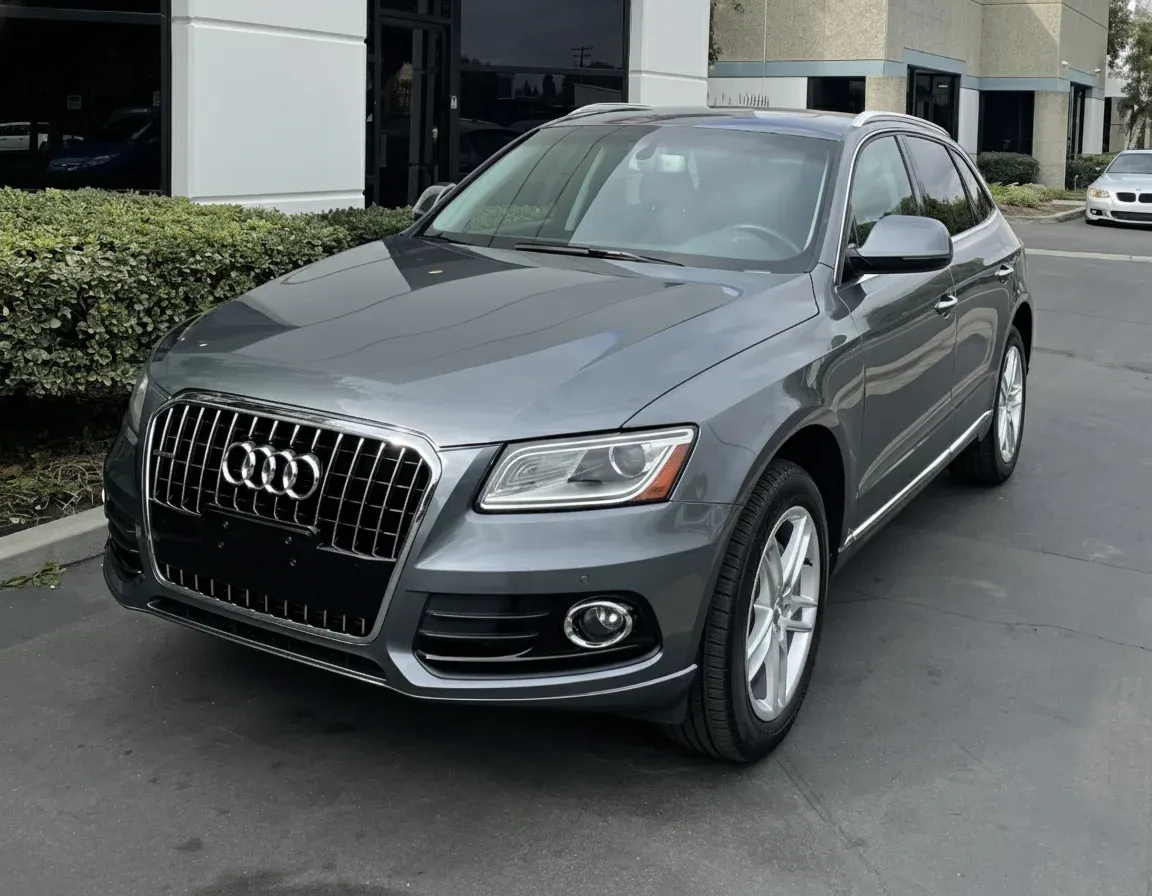
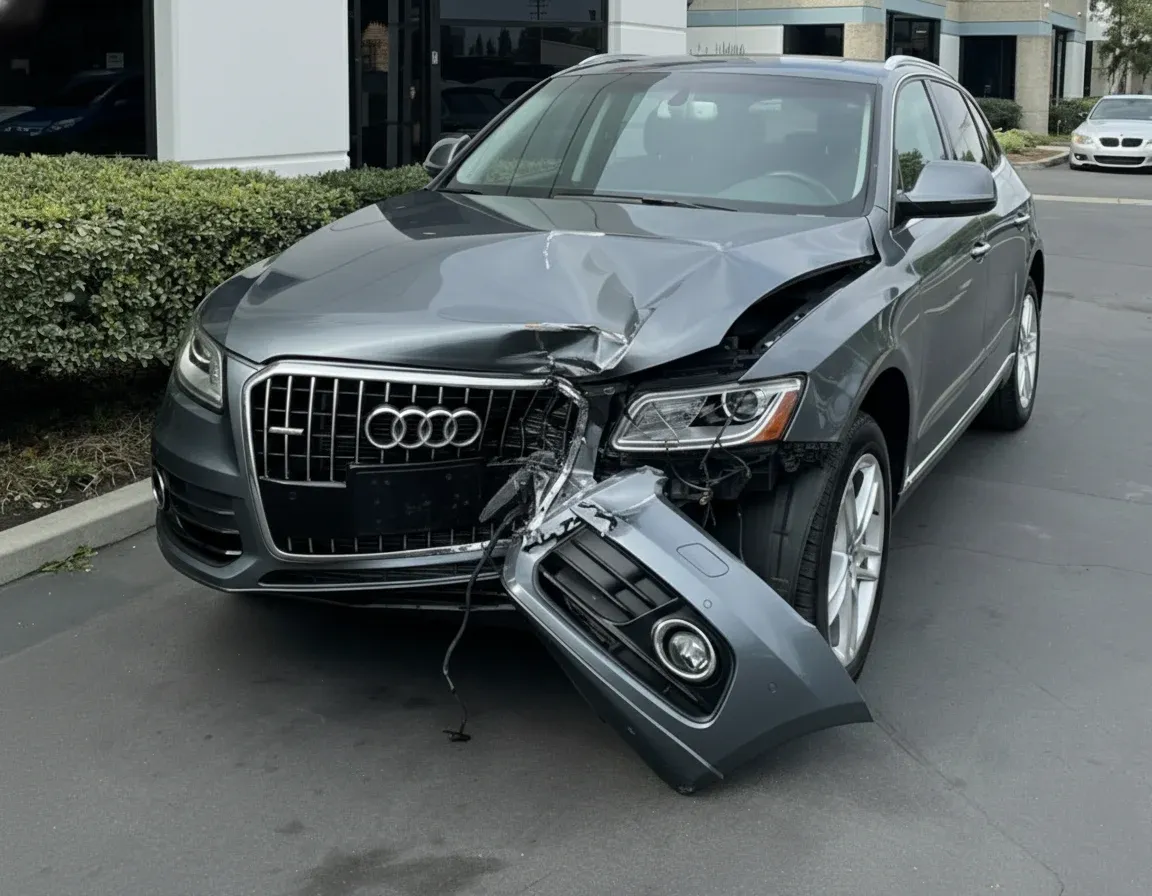
A hood that folded and a cover that came away
The crease across this Q5’s hood runs diagonally from the front corner toward the middle of the panel, which tells you the impact was off-center and had real force behind it. The fender was crushed beneath it, and the bumper cover had pulled clean off its mounts and dropped while still attached at one side. The lamp on the struck side was damaged at its edge and at its mounting.
On a compact premium SUV, that combination almost always means work behind the panels. The cover mounts to a reinforcement bar bolted to the front rails, so if the cover came away, either the fasteners or the structure they thread into took the load. Whether the rails themselves moved is a measurement, and it is the difference between a straightforward repair and a structural one. It is also the difference between an estimate that holds and one that grows, which is why the measuring system goes on the car before the parts list is written rather than after the first week.
Six days, and where they went
Six days covered the whole job: teardown and estimate, parts, structural verification, panel work, refinishing, reassembly, and a final check. A front-end repair of this depth carries more parts than a rear corner and more test-fitting than a bumper job, and the schedule reflected that rather than a target somebody wanted to hit. The date came out of the estimate and the car came out on the date.
The parts sequence is what usually decides whether a repair like this runs a week or three. Ordering everything at once, from a teardown that actually found everything, means the car is never sitting in a corner of the shop waiting on one bracket. It is a dull advantage and it is the single biggest reason our timelines hold. The alternative — estimating from photographs and discovering the rest later — is how a six-day repair becomes a month.
- Front end torn down completely and documented before the estimate was final
- Front rails and reinforcement measured against factory specification
- Hood, fender, and lamp assessed individually against repair limits
- All parts ordered in a single pass from a complete damage report
- Panels hung and gapped in primer before the car entered the booth
- Gray metallic mixed from the paint code and blended into the door and cowl
What to look at when the car comes back
Hood alignment is the giveaway on this vehicle. Closed, the hood should sit level with both fenders and leave a parallel gap on each side; open, it should rise and drop on its struts without binding and latch on the first attempt. If the gap tapers toward the windshield, something behind the fender is still out of position, and no amount of adjustment at the hinge will fix that.
Then look at the color where the gray meets the untouched panels, outdoors and at an angle. Silvers and grays are metallics with a strong flake, and flake laid down at a different angle reads lighter or darker than the panel beside it no matter how accurate the mix is. Blending into the door and across the cowl is what removes the edge, and the refinish carries our lifetime warranty.