
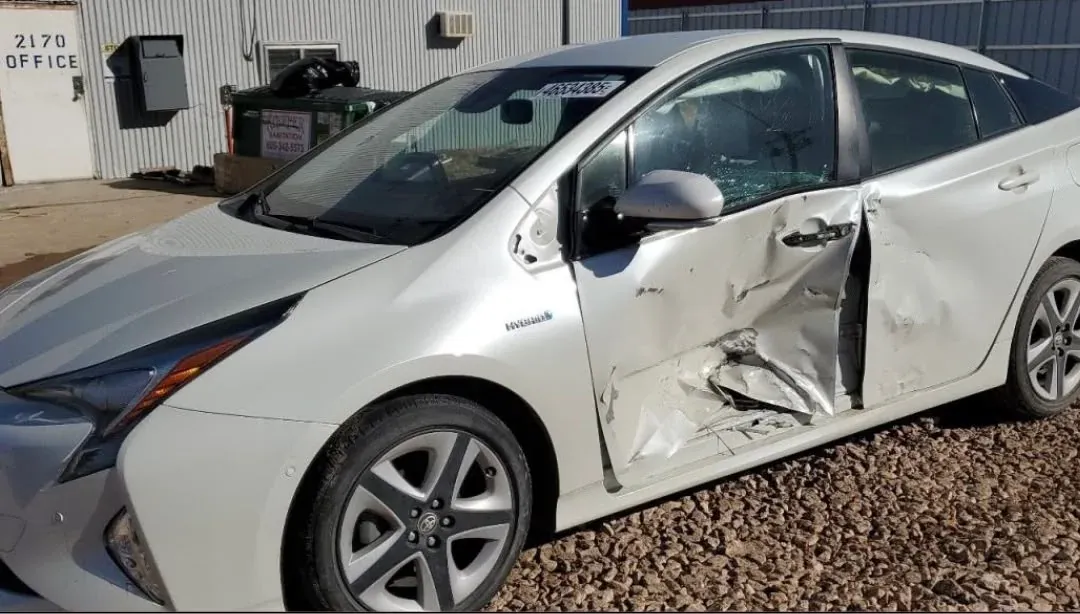
Side impacts leave less room to work with
There is almost nothing between a door skin and the person sitting behind it — a few inches of beam, foam, and trim. That is why this Prius shows the damage it does: both doors buckled inward, the glass gone out of the openings, and the sheet metal torn where the impact concentrated at the middle of the car. The crease then ran rearward into the quarter panel and downward into the rocker.
A hit like this has to be assessed with the interior out. Door cards, trim, and glass come away so the intrusion beams, the B-pillar, and the seat-belt and airbag hardware can all be seen directly. Side curtain systems have sensors mounted in this exact area, and whether or not they deployed, their mounting points and wiring have to be inspected rather than assumed to be fine.
Repairing the doors, rocker, and quarter panel
Doors damaged this severely are replaced, not repaired. A door is a safety structure with a beam inside it, and a beam that has already absorbed an impact does not go back to being what it was. The quarter panel is a different decision — it is welded to the car, so the question becomes whether the damage can be pulled and worked back to shape or whether the panel needs sectioning at factory seams.
The Prius adds one more layer. It is a hybrid, so the high-voltage system is shut down before the side of the car is opened up, and high-voltage cable routing is respected in every decision about cutting, pulling, or welding. None of that is exotic work, but it is work that has to be planned deliberately rather than discovered halfway through the job. The same applies to the glass and the door seals: both go into the plan at the start rather than being added later, because a side repair is not finished until the car is watertight and quiet again.
- Interior trim, glass, and door hardware removed for a full look at the intrusion
- High-voltage system shut down before any cutting or welding
- Rocker, B-pillar, and quarter panel measured against factory specification
- Doors replaced rather than straightened; quarter panel worked back to shape
- Seam sealer and corrosion protection reapplied where the factory had it
- Full side refinished and blended forward and rearward so no edge shows
How to tell a side repair was done properly
Open and close both doors several times. They should swing on the same arc, latch with the same effort, and sit flush with the rocker and quarter panel when closed. A door that needs a shove, or that drops slightly as it opens, is a door hung on a body still out of shape. Run a finger along the bottom edges as well, checking that the seam sealer looks factory rather than smeared.
Then step back fifteen feet and look down the side of the car with light raking across it. A whole flank is the most demanding refinish on any vehicle because there is nowhere to hide a transition, and a good one shows a single unbroken reflection from headlight to taillight. Water testing matters too: with new glass and new seals, nothing should whistle at highway speed or wet a carpet in the rain.