A dent with no tear is still a paint job
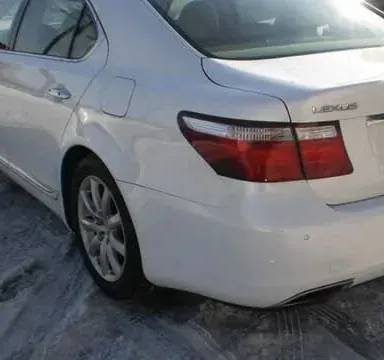
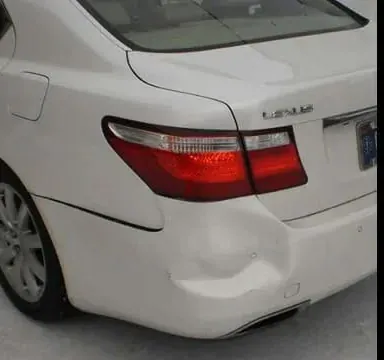
The damage here is the kind that comes from slow, blunt contact: a wide, shallow depression pushed into the corner of the bumper cover with the surrounding surface undisturbed. There is no crack, no split at the seams, and only minor paint disturbance at the deepest point. On a large sedan with a long, unbroken rear flank, that shallow dish is visible from thirty feet because it interrupts the reflection.
It is tempting to expect a dent like this to be pushed out and left alone. In practice, a plastic cover that has been deformed and reshaped needs refinishing to look right, because the surface will not return to a factory-flat reflection on its own and the clear coat has been stressed at the deepest point. Restoring the contour and refinishing the panel is the repair that lasts. It is also the only version that keeps its appearance, because a reshaped surface left unpainted holds micro-cracks that dull and whiten within a season or two.
Restoring the contour
The cover came off the car so the dent could be worked from behind with the shape supported from the front, which is the only way to move a large area evenly instead of creating a ring of high spots around the low one. Heat is used carefully on plastic — enough to let the material relax back toward its molded shape, not enough to distort it further or damage the primer underneath it.
Once the contour was back, the surface was checked with a guide coat and raking light rather than by hand, because the eye finds shallow waves that fingers miss entirely. Anything remaining was corrected with the thinnest possible skim rather than buried, and the panel was primed, blocked flat, and sprayed with flexible material suited to plastic. Filler is a leveling tool on a repair like this, never a shape.
- Bumper cover removed so the dent could be supported and worked from behind
- Contour brought back with controlled heat rather than forced in one push
- Surface checked with a guide coat and raking light for shallow waves
- Minimal skim, then primed and blocked flat before any color
- Paint code read from the vehicle, mixed by computer, checked on a sprayout card
- Refinish blended into the quarter panel so no edge falls on a body line
Matching white on a car like this
White is the most common car color and the least straightforward to match. Factory whites range from flat solids to pearls built from several layers, and a pearl has to be sprayed in the right sequence and at the right film thickness or it reads gray or gold against the panel beside it. The paint code gives us the formula; the sprayout card tells us whether that formula still matches this particular car after years of sun.
That is why the repair was blended rather than cut off at the panel edge. A blend spreads any remaining difference across a distance the eye cannot resolve, and on a rear corner that means carrying color up into the quarter panel. The finished work on this LS is covered by our lifetime refinish warranty, which is the part that matters if a white ever does decide to move.