
Is collision repair different for an electric car?
Quick answer
In some important ways, yes. The high-voltage system has to be de-energized and disconnected per the manufacturer’s procedure before structural work, welding, or anything near the battery. The pack sits in the floor, so underbody and rocker damage is treated seriously. Lifting and jacking follow published points, and driver-assist calibration is required more often. Paint and panel work itself is unchanged.
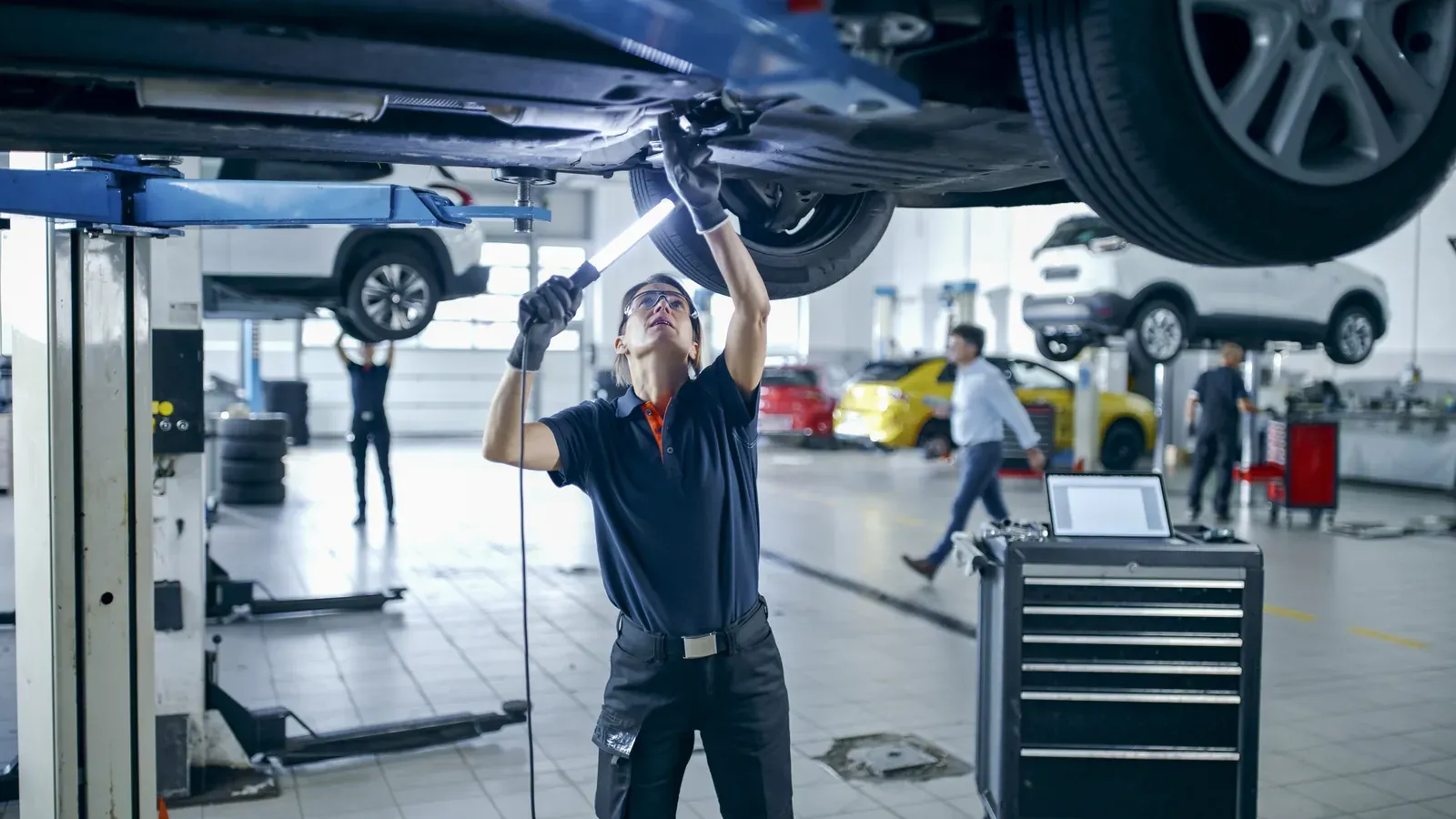
What is exactly the same
An EV bumper cover is a bumper cover. A dented aluminum door is repaired or replaced on the same logic as any other aluminum door. Refinishing is identical — the same color matching, the same blending into adjacent panels, the same downdraft booth and bake cycle.
Estimating, insurance handling, and your right to choose your own shop under Minnesota law are all unchanged as well. You are not required to use a shop your insurance recommends because the car is electric.
So a large share of EV collision work is ordinary body work that any competent shop performs the same way it always has. The differences concentrate around the high-voltage system and the structure it lives in, not around the parts of the car you can see.
The high-voltage system comes first
An EV traction battery operates at hundreds of volts of direct current, which is more than enough to be lethal, and unlike a gasoline vehicle there is no ignition key position that makes it inert.
Before structural repair, welding, cutting, drilling, or any work in the area of the pack or its cabling, the high-voltage system is de-energized and disconnected following the manufacturer’s published procedure. That typically involves removing a service disconnect or manual service plug, then waiting a specified period for the capacitors in the inverter and other components to discharge before anyone works on the vehicle.
Orange cabling marks high-voltage circuits, and those runs are not all obvious — they cross the underbody, run along the tunnel, and go to the charge port, the heater, and the compressor. Nobody drills, cuts, or places a weld ground clamp before locating them on the vehicle’s published diagrams.
These are procedural steps, not equipment claims. They exist because the manufacturer says to do them, and a shop either does them or it should not have the car.
The sequence, in short:
- Look up the published high-voltage disable procedure for that exact vehicle
- Remove the service disconnect or manual service plug and secure it
- Wait the specified capacitor discharge period before working on the vehicle
- Verify the system is de-energized rather than assuming it
- Map every orange high-voltage run before drilling, cutting, or grinding
- Keep welding ground clamps close to the weld and away from high-voltage components
- Reconnect, verify, and scan the vehicle before it goes back to the customer
The battery is part of the structure
In most modern EVs the pack is a large, flat, sealed case bolted into the floor between the axles, and it contributes to the vehicle’s stiffness. That single fact changes how underbody damage is treated.
A rocker panel hit, a curb strike, running over debris, or a hard pothole all put force into the area around the pack. Manufacturers publish inspection criteria for those events and restrict what can be repaired near the enclosure, because heat from welding and the forces of a structural pull do not belong next to lithium cells.
Lift and jack points are published for the same reason. The pack case cannot take the load of a lift arm or a floor jack, and a pad placed in the wrong spot can deform the enclosure. Using published points is a basic requirement on any EV, including for a tire shop or a tow operator.
If your EV took an underbody or rocker impact, expect any competent shop to tell you the pack has to be evaluated per the manufacturer’s procedure before the repair plan is finalized.
Other practical differences
A handful of items come up on most EV repairs:
- More aluminum and mixed materials, which need separate tooling and a dedicated work area so steel dust does not start galvanic corrosion
- Manufacturer-specific limits on paint bake temperature and duration when a pack is installed
- Heavier vehicles, so a crash at a given speed puts more energy into the structure than the equivalent gas model
- Denser sensor packages, so driver-assist calibration is required after more kinds of repair
- Parts that are only available through the manufacturer’s channel, which can extend the timeline
- Storage rules for a vehicle with a suspected damaged pack, including outdoor spacing while it is monitored
- Some structures — particularly large castings and battery-integrated floors — that the manufacturer does not permit to be sectioned at all
- Underbody aerodynamic panels and shields that have to be refitted correctly for range and cooling
How we handle EVs at our shop
We are an independent shop. We do not hold manufacturer certification or brand approval, and we will never tell you otherwise. What we do is pull the published repair procedures for the specific vehicle in front of us and follow them, including the high-voltage and battery instructions.
That also means being straight with you about limits. If a repair on your EV requires access, tooling, parts, or authorization that belongs with the manufacturer’s network, we say so at the estimate — before you leave the car, not after we have had it for a week.
It also means asking the questions that matter before the work starts. Whether the pack needs evaluation, whether the parts can be obtained, and whether any operation on the plan is one the manufacturer restricts — all of that belongs in the estimate conversation, not in a phone call two weeks later.
For cosmetic and bolt-on work, paint, and refinishing, an EV is a car like any other, and our lifetime paint and refinish warranty applies the same way.