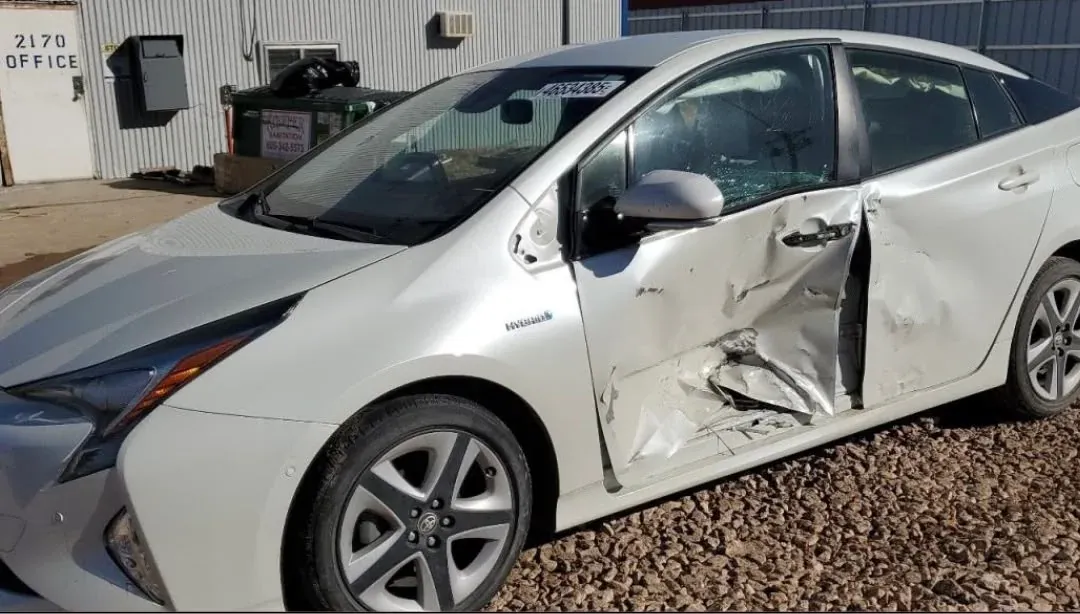
RISE is Mitsubishi’s name for how the body absorbs a hit
Mitsubishi engineers its bodies under a program it calls Reinforced Impact Safety Evolution, a structure designed to channel crash energy around the cabin and let the ends deform in a controlled sequence. The idea is straightforward and the consequence for repair is specific: those crush zones only perform as designed if what replaces them matches what was there, in the right material and joined at the right points. A crush zone rebuilt from the wrong parts is still a crush zone on paper and not in practice.
The current Outlander shares its platform with corporate alliance partners and carries substantial high-strength content through the pillars and rockers. That material cannot be heated or straightened without permanently losing strength, so structural triage happens on the laser measuring system rather than by eye, with readings taken before any correction and again afterward and both sets kept in your file. Mitsubishi publishes those dimensions, so there is no defensible reason to work from a technician’s sense of how the car ought to sit.
The Outlander PHEV carries a battery between the axles
Mitsubishi has built plug-in hybrid Outlanders longer than most manufacturers, and the layout puts the high-voltage battery in the floor between the axles with electric motors at both ends. That means rocker panel and floor damage sits directly against the pack, and it means the underside of the vehicle is not a place to improvise with a hoist arm — lift points are the ones Mitsubishi specifies.
Before any welding, cutting or structural pulling, the high-voltage system is shut down and allowed to discharge, and the pack case, mounts and cabling are inspected wherever the impact landed. Whatever we find gets documented in writing for you and for your insurance company. A gasoline Outlander needs none of that, which is why the plug-in gets its own written sequence. The two look identical in a parking lot, and that is exactly the problem.
- Structural members replaced at published joints rather than heated or pulled
- High-voltage system de-energized before any welding or cutting on plug-in models
- Lifting only at the manufacturer’s specified points on hybrid vehicles
- Pre-repair and post-repair diagnostic scans filed with your estimate
Sensors, premium reds and getting the finish right
Mitsubishi’s forward collision mitigation and adaptive cruise systems read from a camera at the windshield and a sensor at the front of the vehicle, with corner units at the rear on models with blind spot warning. All of it lives on the exact surfaces a collision reaches first, so scanning before teardown and after reassembly is standard here, and calibrations published for the work performed are completed before delivery. A camera that was moved and never re-aimed still shows a picture, which is what makes it so easy to miss.
On color, Mitsubishi’s premium reds are layered finishes where translucent color sits over a base and the pass count sets the depth. Those get a sprayed test card built the same way the panel will be built, checked against your car in booth light and outdoors, adjusted, then blended into the neighboring panels. The refinish carries our lifetime paint warranty for as long as the vehicle is yours.